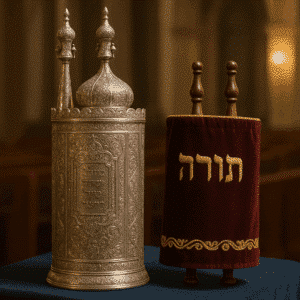
Choosing the right size for a Sefer Torah is not merely a matter of aesthetics or budget — it’s a decision that affects reading comfort, adherence to local customs, and the longevity of the scroll. This guide provides a clear overview of the most common formats used today, along with concrete criteria to help make an informed choice — whether for a synagogue, a beth midrash, a small oratory, or a traveling Torah.
Understanding Sefer Torah Formats Today
In contemporary practice, three main size categories are generally distinguished. The “gadol” format includes large scrolls, usually about 60–70 cm (24–28 inches) high, appreciated for their readability and majestic presence during solemn services. The “beinoni” or medium size, around 50–55 cm (20–22 inches), is very popular as it balances comfort, manageability, and durability. Finally, the “katan” or compact formats, ranging from 35–45 cm (14–18 inches), are ideal for easy transport and use in small spaces, while remaining, when written according to halachic standards, perfectly valid for public reading.
Beyond height, other dimensions also shape the reading experience. The width of the columns, the size of the letters, and the number of lines per column — often forty-two in many traditions — determine the level of clarity. A sofer may adjust spacing and margins to balance readability and compactness, but smaller scrolls require thinner letters, demanding exceptional mastery in writing and more attentive reading.
Weight also varies significantly depending on size and materials. A medium Sefer Torah often weighs between 4 and 7 kg, while a large one can reach 8 to 12 kg. Smaller scrolls may weigh under 4 kg. The thickness of the klaf, the choice of atzei ḥayim (wooden rollers), and — in Sephardic communities — the presence of a rigid silver tik all influence total weight. The tik offers protection and a different carrying method, whereas Ashkenazi-style scrolls, wrapped in velvet mantles, are lighter but require greater care when handled.
Choosing the Right Size: Usage and Tradition
The primary factor remains the intended use. For an active synagogue with several baalei koreh and a diverse congregation, a beinoni format offers the best balance — easy to read on the bimah, manageable for hagbahah and gelilah, and durable enough for frequent use throughout the year. Larger communities sometimes reserve a gadol scroll for holidays and major events, where its visual presence enhances the sense of solemnity. Conversely, a small study hall, yeshiva, or traveling minyan benefits from a katan scroll that’s easier to carry and store.
Local customs also play a key role. Scrolls protected by a rigid tik, common among Sephardic communities, are ideal for processions and readings in various locations, as the case provides both safety and stability. In the Ashkenazi world, where the soft velvet mantle is the norm, a medium-sized Torah limits strain during hagbahah and reduces the risk of slipping. Some communities prefer larger letters to allow congregants to follow along more easily; others value lightness so that older or less experienced members can lift and carry the Torah comfortably.
It is also essential to consider the dignity of public reading (kavod hatsibur), the available space in the Aron HaKodesh, and the financial aspect. A very small Torah can be fully kosher, yet some traditions avoid overly tiny letters to preserve the solemnity and clarity of the reading. The Holy Ark must accommodate the scroll’s height and the width of its handles — especially if it includes a tik. From a budget perspective, size impacts the amount of parchment, writing time, and therefore cost. The beinoni format often remains the most practical solution, but it’s worth discussing details such as column density, ink, klaf type, and finishing touches with the sofer, as these factors affect both durability and price.
Whether destined for a large synagogue or a small neighborhood minyan, choosing the right Sefer Torah size is about finding balance between readability, ease of handling, tradition, and practical needs. By consulting an experienced sofer and considering local customs, available space, and the profile of the readers, one can select a scroll that both honors the Torah and best serves the community. A good Sefer Torah is not only beautiful to behold — it is comfortable to carry, clear to read, and faithful to the sacred tradition that gives it life.
The Transmission of the Oral Torah Why are there disagreements in Halacha if the Oral Torah was faithfully transmitted from one generation to the next? The example of Rashi and Rabbeinu Tam Tefillin helps us understand how halachic disputes could arise without undermining the deep unity or authenticity of the tradition. Based on a response…
A mezuzah is often the first Jewish object one notices when entering a home. It is discreet, sometimes enclosed in a very simple case, yet it contains one of Judaism’s most fundamental texts: the Shema Yisrael. It accompanies the family as they enter and leave, sleep, eat and live the ordinary moments that make up…
On Tisha B’Av, many men do not wear tefillin at Shacharit and wait until Mincha. Yet this practice is not universal. The ancient custom of Jerusalem is specifically to wear them in the morning. To understand this apparent contradiction, we must return to the laws of mourning, to the word pe’er, meaning “glory” or “adornment,”…
When looking at a Sefer Torah, a pair of Tefillin, or handwritten Mezuzah scrolls, the eye is naturally drawn to the beauty and precision of the calligraphy. Yet few people stop to consider the vital substance that makes this sacred writing possible: Dyo, the special black ink used by a Sofer STaM. In the world…
By Daniel Malka, Certified Sofer STaM | Updated in 2026 Does your caravan, mobile home, campervan, or RV require a Mezuzah? A Sephardic halachic answer based on the Shulchan Aruch and the rulings of Rabbi Ovadia Yosef zt”l. 📋 Table of Contents The basic principle: What is considered a home? The caravan: With or without…
The Halacha of Tefillin Are women required to wear Tefillin, and may they choose to wear them voluntarily? The answer requires distinguishing between three levels: the basic obligation, the exceptional cases mentioned in the Talmud, and the practical ruling accepted by the halachic authorities. Practical answer: women are exempt from the mitzvah of Tefillin because…