


Why Don’t We Wear Tefillin on Tisha B’Av?
On Tisha B’Av, many men do not wear tefillin at Shacharit and wait until Mincha. Yet this practice is not universal. The ancient custom of Jerusalem is specifically to wear them in the morning. To understand this apparent contradiction, we must return to the laws of mourning, to the word pe’er, meaning “glory” or “adornment,” and to the different traditions recorded by the halachic authorities.
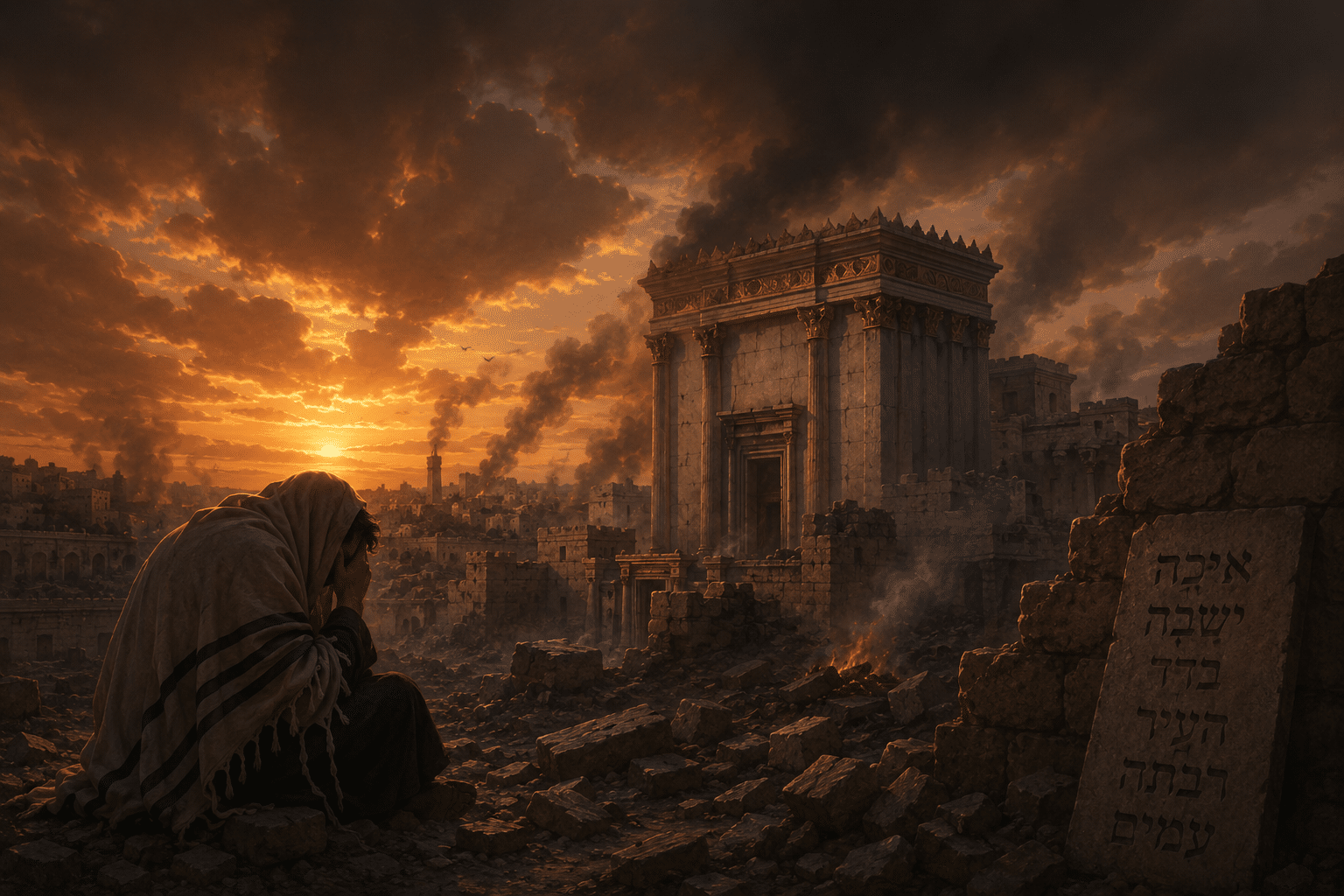
1. The precise answer, a question of timing and custom
The familiar question, “Why don’t we wear tefillin on Tisha B’Av?” suggests that the mitzvah disappears for the entire day. That is not what halachah says. Tisha B’Av is neither Shabbat nor Yom Tov. In principle, it remains a day on which the mitzvah of tefillin applies. The Shulchan Aruch explicitly lists Tisha B’Av among the days on which one is obligated to wear tefillin.2
What changes in many communities is the time at which they are worn. The morning of Tisha B’Av concentrates the most visible expressions of mourning. We sit on the ground or on a low seat, recite Kinot, and remain immersed in the destruction. In this setting, wearing the “adornment” is postponed until Mincha. Maran writes:
נוהגים שלא להניח תפילין בתשעה באב שחרית… ובמנחה מניחים ציצית ותפילין ומברכים עליהם
“The custom is not to put on tefillin on the morning of Tisha B’Av… At Mincha, one puts on tzitzit and tefillin and recites the blessings over them.”
Shulchan Aruch, Orach Chaim 555:1
The decisive word is nohagim, “the custom is.” The text codifies a strong and widely accepted custom, but the halachic history of the subject is older and more diverse. Some authorities held that tefillin should be worn in the morning because Tisha B’Av should not be treated more severely than individual mourning, in which the tefillin restriction is limited to the first day. This approach explains the morning practices preserved in certain Sephardic communities.3
The Sephardic priority, preserve the established custom and avoid dispute
The Yalkut Yosef distinguishes between several practices. According to the ancient Jerusalem custom, Shacharit is prayed publicly with tallit and tefillin. Where the public custom is to wear them only at Mincha, it is recommended to put on Rashi tefillin at home beforehand and, for one who wears them daily, Rabbeinu Tam tefillin as well, and to recite the Shema while wearing them. They are then removed before joining the public service, and Rashi tefillin are worn again at Mincha with a blessing.1
This second wearing at Mincha does not constitute an unnecessary repeated blessing. When a person removes his tefillin intending to put them on much later, at the afternoon service, he recites the blessing again according to the ruling cited here. Rav Yitzhak Yosef is also very clear about communal life. In one synagogue, part of the congregation should not act publicly in one way while another part acts in the opposite way. The community should agree on a single public practice and avoid forming opposing groups, taking into account the prohibition of lo titgodedu.1
2. Why are tefillin called pe’er, the “adornment” of Israel?
The best-known reason for not wearing tefillin at Shacharit on Tisha B’Av is contained in one Hebrew word, פְּאֵר, pe’er. It may be translated as adornment, glory, or a dignified ornament. This is not merely a poetic title later attached to tefillin. The word appears in a painful prophetic episode, and the Gemara derives a practical law of mourning from it.4
The verse in Yechezkel
In chapter 24 of Yechezkel, God tells the prophet that his wife will die. Yechezkel receives an exceptional command not to display the usual public signs of mourning. He is told:
הֵאָנֵק דֹּם מֵתִים אֵבֶל לֹא־תַעֲשֶׂה פְּאֵרְךָ חֲבוֹשׁ עָלֶיךָ
“Sigh in silence, do not observe mourning for the dead, bind your adornment upon yourself.”
Yechezkel 24:17
In the plain meaning of the verse, pe’er refers to a dignified headdress. Radak explains that a mourner ordinarily leaves his head uncovered, while Yechezkel was commanded to retain his head covering.5 The Sages reveal an additional halachic meaning, this “adornment” refers to tefillin. This does not erase the plain meaning of the verse. It is the Talmudic interpretation through which the verse becomes the source for the special status of tefillin during mourning.
The reasoning is precise. If God had to command Yechezkel specifically to keep his adornment while withholding the normal rites of mourning, an ordinary mourner must normally refrain from wearing it. Otherwise, the command would contain nothing exceptional.
What the Gemara says
In tractate Sukkah, Rav teaches that a mourner remains obligated in the mitzvot of the Torah, with the exception of tefillin, because they are called pe’er. The Gemara infers from the order given to Yechezkel, “You are required to wear them, but other mourners are exempt.” It then limits this exemption to the first day of mourning, described by Scripture as a “bitter day.”6
The same derivation appears in Moed Katan. It was later codified by Maran, an individual mourner does not wear tefillin on the first day of mourning.7
An adornment bearing the Name of God
The Gemara in Berachot also describes tefillin as a source of strength for Israel. Regarding the verse, “All the peoples of the earth will see that the Name of God is called upon you and they will fear you,” Rabbi Eliezer HaGadol teaches, “This refers to the tefillin of the head.”8
The tefillah shel rosh is worn at the most visible place on the body. Yet it is not jewelry in a secular sense. Its beauty lies in making Israel’s attachment to God visible. The restrained black of the boxes and straps, their carefully regulated form, and the hidden parchments within express dignity governed by Torah.
From a sofer’s perspective, this idea is tangible. On the outside, the box is closed, black, and silent. Inside, every letter must be present, distinct, and written in the required order. The true adornment of tefillin is therefore not decorative. It unites what is visible, the sign worn on the body, with what remains hidden, the words of Torah written on parchment.
Why this symbol is central to Tisha B’Av
Tisha B’Av applies several laws of individual mourning to the entire people. The Mishnah and Gemara teach that practices imposed upon a mourner apply on that day, including refraining from eating and drinking, washing, anointing, leather footwear, and marital relations.9 This comparison naturally raises the question of tefillin. If the entire people stands as a mourner before the destruction of the Temple, should it wear its adornment?
Here lies the tension. On the one hand, tefillin remain a mitzvah of the day, and the individual mourner’s exemption is limited. On the other hand, the morning of Tisha B’Av is the most intense moment of national mourning. Some communities therefore remove the adornment at Shacharit and during Kinot and restore it at Mincha. Others retain the morning wearing, holding that the mourner’s exemption should not be extended to the whole day of Tisha B’Av.
3. Tisha B’Av and the status of a mourner, a real but limited comparison
Two shortcuts must be avoided. The first says, “Tisha B’Av is a day of mourning, therefore every law of shivah applies automatically.” The second says, “It is merely a communal fast, therefore the laws of mourning are irrelevant.” Both are too simple.
The Gemara establishes a direct connection between Tisha B’Av and personal mourning, but within a defined scope. Certain restrictions of the mourner become restrictions for all Israel, while other laws are not transferred in precisely the same form.
“All the practices of a mourner apply on Tisha B’Av”
כל מצות הנוהגות באבל נוהגות בתשעה באב
“All the practices that apply to a mourner apply on Tisha B’Av.”
Talmud Bavli, Taanit 30a
The baraita immediately specifies what it includes. Eating, drinking, anointing, wearing shoes, and marital relations are forbidden. It also limits ordinary Torah study. One may instead study subjects connected to mourning and destruction, including Iyov, Kinot, and painful passages in Yirmiyahu.10
Tisha B’Av is therefore not only a day of hunger. The fast engages the body, study, posture, and atmosphere of the day. Israel collectively takes the place of a mourner.
Why ordinary Torah study is limited
Torah study normally brings joy, as the verse says, “The precepts of God are upright, rejoicing the heart.” Halachah therefore considers not only the technical category of a mitzvah, but also what that mitzvah expresses at a particular moment.11 The same is true of tefillin in communities that postpone them until Mincha. They do not become intrinsically forbidden or less holy. Their status as pe’er is difficult to reconcile with the hours of greatest mourning.
The essential limit
The Gemara’s statement does not mean that every detail of individual mourning is copied onto Tisha B’Av. The day is not a miniature shivah. The fast itself, for example, has no general parallel throughout the seven days of personal mourning. Each rule must be examined through the Talmud, the Rishonim, and the accepted custom.
The practice of sitting on the floor or on a low seat resembles individual mourning, but it is not maintained with the same severity all day. The Shulchan Aruch records sitting on the ground until Mincha, while other customs allow normal seating somewhat earlier.12
Is Tisha B’Av comparable to the first day of mourning?
For an individual mourner, tefillin have a special status. The Gemara discusses when they are resumed, and the Rambam states that the mourner is exempt “on the first day only.” Maran likewise rules that they are not worn on the first day and are resumed afterward according to the detailed laws of mourning.13
But does Tisha B’Av itself correspond to that first day? This is precisely where opinions diverge. Some see the day as concentrating the initial pain of national mourning, making the adornment inappropriate in the morning. Others argue that an old national mourning cannot be more severe than recent individual mourning. A third practical approach preserves both dimensions by avoiding tefillin during the public Shacharit and Kinot while wearing them privately beforehand or publicly at Mincha.
4. The Geonim and Rishonim, why the early authorities describe different practices
The Gemara does not directly formulate our modern practical question, “Shacharit or Mincha?” Detailed responses appear in the literature of the Geonim, and the Rishonim organize the sources around different understandings of mourning.
Rav Sheshna Gaon
A responsum attributed to Rav Sheshna Gaon states that tefillin may, and indeed should, be worn on Tisha B’Av. His reasoning is based on individual mourning. If tefillin are resumed after the first day of a recent bereavement, all the more so should the mitzvah not be cancelled during an ancient mourning for the Temple. The responsum states that this was the practice of the two great Babylonian academies.14
בתשעה באב גופו מותר להניח תפילין
“On Tisha B’Av itself it is permitted to put on tefillin.”
Responsa of the Geonim, Shaarei Teshuvah 155
Rav Hai Gaon is also cited as permitting tefillin on that day, and the Rashba associates this position with the Ramban’s approach.15
Ramban, Tosafot, and Rosh
In Torat HaAdam, the Ramban writes explicitly that one is obligated in tefillin on Tisha B’Av. Tosafot compare the day not to the full severity of the first day of mourning, but to the subsequent days when tefillin are resumed. The Rosh also records the obligatory view and resists treating Tisha B’Av more strictly than the Talmudic sources warrant.16
These authorities do not deny that tefillin are an adornment. They argue that the symbolism of mourning cannot by itself suspend a positive commandment for the whole day.
Maharam of Rothenburg and Rokeach
Another approach developed in European communities. Maharam of Rothenburg did not wear tefillin on Tisha B’Av. The Rosh records this practice without adopting it as the universal conclusion. The Rokeach links the absence of the tallit to the verse in Eichah, “He tore His pavilion like a garden,” and the absence of tefillin to the verse, “He cast down from heaven to earth the glory of Israel.” Since Israel’s glory was cast down, the adornment is not displayed during the darkest part of mourning.17
Raavad, Rambam, and Meiri
The Raavad reports the prohibitive view and describes his own cautious practice, he did not wear tefillin and instead placed ashes at the place of tefillin. His personal conduct does not necessarily establish an uncontested prohibition for everyone.18
The Rambam does not state a general prohibition. He writes that some sages would not wear the head tefillin on Tisha B’Av. Maggid Mishneh understands that, according to strict law, they may be worn as on other days, while the Rambam describes a practice of heightened mourning. Meiri similarly records the non-wearing as a commendable custom of mourning without erasing the basis of the permissive position.1920
How these views led to the Mincha practice
The widespread practice of Mincha creates a careful balance. It preserves the removal of adornment during Shacharit, Eichah, and Kinot, then restores tefillin when the visible intensity of mourning begins to ease in the afternoon. The mitzvah is not abandoned, its performance is moved within the day.21
5. What exactly does the Shulchan Aruch rule?
Two passages of Maran Rabbi Yosef Karo must be read together. In the general laws of tefillin, he states that one is obligated to wear tefillin on Tisha B’Av. In the laws of the fast, he records the custom not to wear them at Shacharit and to wear them at Mincha with a blessing. These rulings do not contradict one another. The first establishes the obligation of the day, while the second regulates its timing according to the recorded custom.2223
“On Tisha B’Av one is obligated in tefillin.” The day is neither Shabbat nor Yom Tov and the mitzvah is not cancelled.
According to the custom recorded there, tallit and tefillin are not worn at Shacharit. They are worn at Mincha with their blessings.
The first text, the obligation remains
Orach Chaim 38 distinguishes the first-day mourner, who is exempt, from Tisha B’Av, about which Maran writes explicitly, “On Tisha B’Av one is obligated in tefillin.” This is the language of obligation, not merely permission. It follows the approach of the Ramban, Rosh, and other Rishonim.22
This closes the door to a common mistake. Where the custom is not to wear tefillin at Shacharit, this does not mean one is exempt all day. One must arrange to wear them at the time accepted by the community.
The second text, the morning custom
In Orach Chaim 555, Maran uses the language of custom. One does not put on tefillin in the morning, does not wrap oneself in the tallit gadol, wears the tallit katan under one’s clothing without a blessing, and at Mincha puts on tzitzit and tefillin with the blessings.23
ובמנחה מניחים ציצית ותפילין ומברכים עליהם
“At Mincha, one puts on tzitzit and tefillin and recites the blessings over them.”
Shulchan Aruch, Orach Chaim 555:1
Why can the obligation be fulfilled at Mincha?
The mitzvah of tefillin applies during the weekday daytime, but fulfilling it does not require wearing them uninterrupted throughout the day. A valid wearing during the day fulfills the mitzvah. Postponing them until Mincha therefore remains an actual performance of the mitzvah, with the prescribed blessings.25
Why specifically Mincha?
Maran states the time without elaborating on the reason. Magen Avraham explains the morning abstention through the status of tefillin as pe’er. Later commentaries explain their return at Mincha through the easing of certain visible mourning practices and the first element of consolation that emerges within the destruction itself.27
Mishnah Berurah records two explanations. According to one, the Temple began to burn then, and divine anger was poured out upon wood and stone rather than upon Israel. According to another, restoring the adornment expresses that consolation already begins within the day of mourning. These explanations illuminate the custom but are not Maran’s own wording.
Reciting Shema without tefillin
The Gemara compares one who recites Shema without tefillin to one who bears false testimony against himself, because he says, “You shall bind them,” while not performing the command. The commentaries explain that this criticism particularly concerns disregard or rejection of the mitzvah. One who follows a recognized mourning custom and intends to wear tefillin later that day is not abandoning the obligation.26
Nevertheless, to recite Shema in its fullest form, the Yalkut Yosef recommends that in communities where the public Shacharit is prayed without tefillin, each person should put them on at home after Birkot HaTorah, recite Shema, remove them before joining the service, and then wear Rashi tefillin again at Mincha with a blessing.1
6. Sephardic customs, why the community matters more than a national label
There is no single Sephardic custom regarding tefillin on Tisha B’Av. Some communities wear tallit and tefillin during Shacharit. Some put them on privately at home for Shema, then pray publicly without them and wear them again at Mincha. Others wait until Mincha even in private. Rav Ovadia Yosef and the Yalkut Yosef explicitly recognize this diversity while assigning special weight to the ancient custom of Jerusalem.1
Jerusalem and Beit El
The ancient Jerusalem custom is to pray Shacharit publicly with tallit and tefillin. It is particularly associated with the kabbalistic tradition of Beit El and the Rashash, Rabbi Shalom Sharabi. Kaf HaChaim records this practice, and Rav Ovadia Yosef gives it strong halachic support. He writes that it is founded upon great authorities and should not be changed. In some accounts, the tefillin are removed after the Amidah or before Kinot. The exact point of removal depends on the established synagogue rite.28
The Yalkut Yosef goes beyond merely tolerating this custom and praises communities that restore it. Yet this does not authorize an individual to cause division in a synagogue whose public custom is Mincha. The same source requires one coordinated public practice.1
Baghdad according to Ben Ish Chai
Rabbi Yosef Chaim of Baghdad describes an intermediate arrangement. In the morning, a man puts on tallit and tefillin at home and recites Shema while wearing them. He then removes them and goes to the synagogue for Shacharit without tallit and tefillin. Ben Ish Chai criticizes leaving tefillin entirely until Mincha. The private morning wearing preserves the mitzvah and the connection between Shema and tefillin while maintaining the public atmosphere of mourning.29
Morocco according to Rav Shalom Messas
In Shemesh U’Magen, Rav Shalom Messas strongly defends the Moroccan tradition of not wearing tallit and tefillin in the morning and wearing them at Mincha. He rejects using the call to “restore the ancient crown” as a reason to erase a custom inherited from one’s fathers. For him, that custom is itself a living Torah tradition rooted in the status of tefillin as pe’er and in generations of communal practice.30
He is also more restrictive than the Yalkut Yosef regarding a private morning wearing. In the Moroccan framework he defends, such a practice is reserved for one genuinely following the way of the kabbalists, not for anyone who independently wishes to change his custom.
Aleppo and communities combining private morning wearing with public Mincha
The practice of putting on tefillin at home before Shacharit is also attested in contemporary traditions of Aram Tzova. One wears tallit and tefillin privately, recites Shema, joins a public Shacharit without them, and wears them again at Mincha. This is the same structure recommended by Rav Ovadia Yosef for communities that retain Maran’s public Mincha practice.31
When one does not know one’s custom
- Ask before the fast whether the congregation wears tefillin at Shacharit or Mincha.
- Specify your family background and, when known, your father’s practice. “Sephardic” or “North African” is not always precise enough.
- Do not improvise publicly against the synagogue’s practice. Communal unity is itself halachically significant.33
- Prepare for Mincha when that is the local custom. Bring the tefillin and arrive early enough to wear them calmly.
Or LeTzion recognizes that some communities wear them at Shacharit and others at Mincha and that each should preserve its custom. At the same time, it states a preference for the morning practice. This preference does not authorize an individual to oppose the public order of his synagogue.33
7. The ancient Jerusalem custom according to Rav Ovadia Yosef
When Rav Ovadia Yosef defends wearing tefillin at Shacharit on Tisha B’Av, he is not creating an innovation. In Yechaveh Daat II, responsum 67, he gathers testimony showing that this practice existed in Jerusalem decades before the publication of the Shulchan Aruch, was preserved by the kabbalists of Beit El, and later spread to many Sephardic synagogues in the city.34
A testimony dated 5269
Rav Ovadia cites a testimony reproduced in Chaim VaChesed by Rav Chaim Yitzhak Mussafia, preserving rulings of Jerusalem rabbis dated 5269, corresponding to 1508–1509. He understands this document as attesting that the Jews of Jerusalem prayed Shacharit on Tisha B’Av wearing tefillin as on other days. It also states that Rabbeinu Yitzhak Abuhav removed them immediately after the Amidah, before Kinot.35
The date is significant. It predates the publication of the Shulchan Aruch, allowing Rav Ovadia to present the morning wearing not as a later reaction against Maran, but as an ancient local custom that Maran’s codification did not intend to abolish.
Beit El, a public communal practice
Chesed LaAlafim testifies that the Jerusalem kabbalists who followed the Ari and the Rashash wore both Rashi and Rabbeinu Tam tefillin at Shacharit in the Beit El congregation. Kaf HaChaim confirms this practice and notes that other synagogues adopted it as well.36
This was not merely a private practice of a few individuals at home. In Beit El, it was a visible communal rite. That collective dimension is precisely what gives it the status of a synagogue custom rather than a personal preference.
Did the custom prevail throughout Jerusalem?
No. Rav Ovadia cites Kiryat Chana David, which describes the spread of the morning practice in the synagogues and study halls of Jerusalem’s newer neighborhoods. He also mentions older synagogues in the Old City that continued to follow Orach Chaim 555 and waited until Mincha. The Rabban Yochanan ben Zakkai synagogue is cited as preserving this other tradition.37
It would therefore be inaccurate to write, “Everyone in Jerusalem always wore tefillin in the morning.” The careful formulation is that Jerusalem possesses an ancient, widely attested custom of wearing them at Shacharit, while some Jerusalem congregations maintained the Mincha custom.
May an individual adopt the Jerusalem custom alone?
Not publicly against the rite of his synagogue. The Yalkut Yosef praises restoration of the custom within an appropriate communal framework, but in the same passage requires the congregation to act together and avoid two visible, competing practices. One who prays in a synagogue where everyone waits until Mincha should not arrive alone in tallit and tefillin in the name of Jerusalem. He should consult the local rabbi and follow the arrangement adopted by the congregation.38
8. The Ashkenazic custom, why tefillin are generally postponed until Mincha
In the great majority of Ashkenazic communities, the public practice is straightforward. At Shacharit on Tisha B’Av, neither tallit gadol nor tefillin is worn. At Mincha, both are worn with their blessings. This follows the wording of the Shulchan Aruch, Orach Chaim 555:1. The Rema adds no divergent Ashkenazic custom here, and the major Ashkenazic summaries present this as the accepted practice.39
Ashkenazim do not cancel the mitzvah. They postpone its public performance until Mincha. The delay is not caused by fasting alone, since tefillin are normally worn on other public fasts. It is the exceptional mourning of Tisha B’Av and the status of tefillin as pe’er that explain their absence from the morning service.
At Mincha
At Mincha, one wraps oneself in the tallit and puts on tefillin with the usual blessings. This restoration accompanies the gradual easing of certain external signs of mourning. Mishnah Berurah, citing the Vilna Gaon, also links this time to the beginning of the Temple’s burning. Paradoxically, the outpouring of divine anger upon wood and stone already contained an element of mercy toward Israel. Another explanation is that restoring the adornment expresses hope for consolation on the very day of destruction.41
Rabbeinu Tam according to Ashkenazic authorities
Mishnah Berurah states that one who wears Rabbeinu Tam tefillin every day should also wear them at Mincha on Tisha B’Av. Aruch HaShulchan records a different practice and prefers not to wear Rabbeinu Tam tefillin that day, while acknowledging that some do. An Ashkenazic reader should therefore follow his established practice and rabbinic guidance.41
9. Why are tefillin put on at Mincha?
Waiting until Mincha does not mean that Tisha B’Av has ended. The fast and its prohibitions continue until nightfall. What changes is the visible expression of mourning. After the heart of the morning Kinot and lamentations, certain outward signs begin to ease. The Shulchan Aruch expresses this transition by prescribing tallit and tefillin at Mincha with blessings.23
Consolation begins within mourning itself
Mishnah Berurah records two complementary approaches. According to the Vilna Gaon, the afternoon recalls when fire was set to the Temple. Yet the fact that divine anger was poured out upon wood and stone contains a form of mercy toward Israel. According to another explanation, restoring the “adornment” demonstrates that consolation begins symbolically on the very day of destruction.4142
The gesture holds both truths together. In the morning, the absence of tefillin gives bodily form to the loss of pe’er. At Mincha, their return affirms that the covenant between God and Israel remains intact. The black boxes do not erase the pain. They place it within a loyalty that survives destruction.
10. What should one do in practice?
The most important preparation should take place before the fast. Verify the custom of your synagogue. Ask whether tallit and tefillin are worn at Shacharit, at Mincha, or whether a private wearing is recommended before the public service. Mention your family background to the rabbi, since a general label such as “Sephardic” does not always identify the precise custom.133
- Before the fast: ask the rabbi or knowledgeable synagogue official what the congregation’s public custom is.
- Prepare your bag: tallit, Rashi tefillin and, if you wear them daily, Rabbeinu Tam tefillin.
- If the congregation follows the Shacharit custom: wear them with the usual blessings according to the local rite, and remove them at the point prescribed by that rite.
- If the congregation waits until Mincha: follow any private morning wearing directed by your halachic authority, then wear tallit and tefillin at Mincha with blessings.
- During the wearing: proceed calmly as on an ordinary weekday, according to your siddur. There is no additional blessing unique to Tisha B’Av.
- Special circumstances: illness, late arrival, travel, forgetfulness, or attending a synagogue of another rite should be discussed with a rabbi.

For a review of the placement of the shel yad and shel rosh, see our guide to putting on tefillin. Left-handed, ambidextrous, and cross-dominant readers may consult our guide to choosing the correct arm.
11. What about Rabbeinu Tam tefillin?
According to the Yalkut Yosef, one who wears Rabbeinu Tam tefillin every day also wears them on Tisha B’Av at the time prescribed by his custom and according to his ordinary rules of blessing. In the ancient practice of Beit El and Jerusalem, both Rashi and Rabbeinu Tam tefillin are reported at Shacharit. According to the Mincha custom, Mishnah Berurah states that one who wears them daily should wear them at Mincha as well.283641
This is not universal among Ashkenazic authorities, since Aruch HaShulchan records a different practice. Tisha B’Av is not the occasion to begin wearing Rabbeinu Tam tefillin independently. One who does not normally wear them should consult his rabbi.
Frequently asked questions
Are tefillin worn on Tisha B’Av?
Yes. In many communities they are worn at Mincha with a blessing. According to the ancient Jerusalem custom and certain Sephardic traditions, they are worn at Shacharit. One should follow the established custom of one’s community.
Why do many people not wear them in the morning?
Tefillin are called pe’er, an adornment. Many communities remove this adornment during the most intense part of mourning and restore it at Mincha.
What is the Sephardic custom?
There is no single Sephardic practice. The ancient Jerusalem custom wears tallit and tefillin at Shacharit. Other communities follow the practice codified by Maran and wear them publicly at Mincha. In this second setting, the Yalkut Yosef recommends a private morning wearing with Shema.
Are the blessings recited at Mincha?
Yes. According to the ruling of the Shulchan Aruch, tallit and tefillin are worn at Mincha with their usual blessings.
Are Rabbeinu Tam tefillin also worn?
According to the Yalkut Yosef and Mishnah Berurah, one who wears them daily also wears them on Tisha B’Av at the time corresponding to his custom. Some Ashkenazic authorities record a different practice.
What if my synagogue follows a different custom from my family?
Do not create two competing public practices. Explain your family tradition to the rabbi before the fast, and he will advise how to preserve your personal custom while respecting the unity of the minyan.
Placement, straps, boxes, or inspection, speak directly with a Sofer STaM.
Main sources
- Yalkut Yosef, Hilchot Tisha B’Av, siman 555, paragraphs 1–2; Rav Ovadia Yosef, Yechaveh Daat II, responsum 67, and VI, responsum 2; Chazon Ovadia, Arba Ta’aniyot, laws of Tisha B’Av; Halichot Olam II.
- Shulchan Aruch, Orach Chaim 38:6.
- Rosh, Taanit IV:37; see the discussion in Yechaveh Daat II:67.
- Yechezkel 24:15–18, especially verse 17.
- Radak on Yechezkel 24:17.
- Talmud Bavli, Sukkah 25a–25b; see also Berachot 11a.
- Talmud Bavli, Moed Katan 15a; Shulchan Aruch, Yoreh Deah 388:1.
- Talmud Bavli, Berachot 6a, on Devarim 28:10.
- Mishnah and Talmud Bavli, Taanit 30a.
- Talmud Bavli, Taanit 30a; Shulchan Aruch, Orach Chaim 554:1–2.
- Tehillim 19:9; Taanit 30a; Shulchan Aruch, Orach Chaim 554:1.
- Tur, Orach Chaim 555; Shulchan Aruch, Orach Chaim 559:3.
- Talmud Bavli, Moed Katan 21a; Rambam, Hilchot Avel 4:9; Shulchan Aruch, Orach Chaim 38:5 and Yoreh Deah 388:1.
- Teshuvot HaGeonim, Shaarei Teshuvah, responsum 155, attributed to Rav Sheshna Gaon.
- Teshuvot HaRashba V:214; Ramban, Torat HaAdam, Shaar HaAvel.
- Tosafot on Moed Katan 21b; Rosh, Taanit IV:37.
- Maharam of Rothenburg, Hilchot Semachot 51, cited by Rosh; Rokeach 310, on Eichah 2:6 and 2:1.
- Raavad, Tamim Deim 40.
- Rambam, Hilchot Taaniyot 5:11; Maggid Mishneh ad loc.
- Meiri, Beit HaBechirah, Taanit 30a.
- Shulchan Aruch, Orach Chaim 38:6 and 555:1.
- Shulchan Aruch, Orach Chaim 38:6; Beit Yosef, Orach Chaim 38.
- Shulchan Aruch, Orach Chaim 555:1.
- Shulchan Aruch, Orach Chaim 30 and 555:1.
- Talmud Bavli, Berachot 14b; Meiri ad loc.; Rema MiPano, Alfasi Zuta, Berachot 14b.
- Magen Avraham, Orach Chaim 555:1; Mishnah Berurah 555:1–3.
- Kaf HaChaim, Orach Chaim 555:4; Chesed LaAlafim, Orach Chaim 38:3; Rav Ovadia Yosef, Yechaveh Daat II:67; Chazon Ovadia, Arba Ta’aniyot.
- Ben Ish Chai, first year, Parashat Devarim, paragraph 25.
- Rav Shalom Messas, Shemesh U’Magen II, Orach Chaim, responsum 6; related responsum in volume III, responsum 7, subject to the numbering of the edition used.
- Documented study of the contemporary Aram Tzova custom; Yalkut Yosef, siman 555, paragraph 1.
- Or LeTzion III, chapter 29, question 22; Yalkut Yosef, siman 555, paragraph 1.
- Rav Ovadia Yosef, Yechaveh Daat II:67; Chazon Ovadia, Arba Ta’aniyot; Halichot Olam II.
- Chaim VaChesed by Rav Chaim Yitzhak Mussafia, collection of rulings of Jerusalem rabbis dated 5269, cited in Yechaveh Daat II:67.
- Chesed LaAlafim, Orach Chaim 38:3; Kaf HaChaim, Orach Chaim 555:4.
- Kiryat Chana David II, cited and discussed in Yechaveh Daat II:67.
- Yalkut Yosef, Hilchot Tisha B’Av, siman 555, paragraphs 1–2.
- Shulchan Aruch, Orach Chaim 555:1; Mishnah Berurah 555:1–2; Chayei Adam 135:18.
- Mishnah Berurah, siman 555; Aruch HaShulchan, Orach Chaim 555.
- Talmud Bavli, Taanit 29a. .


